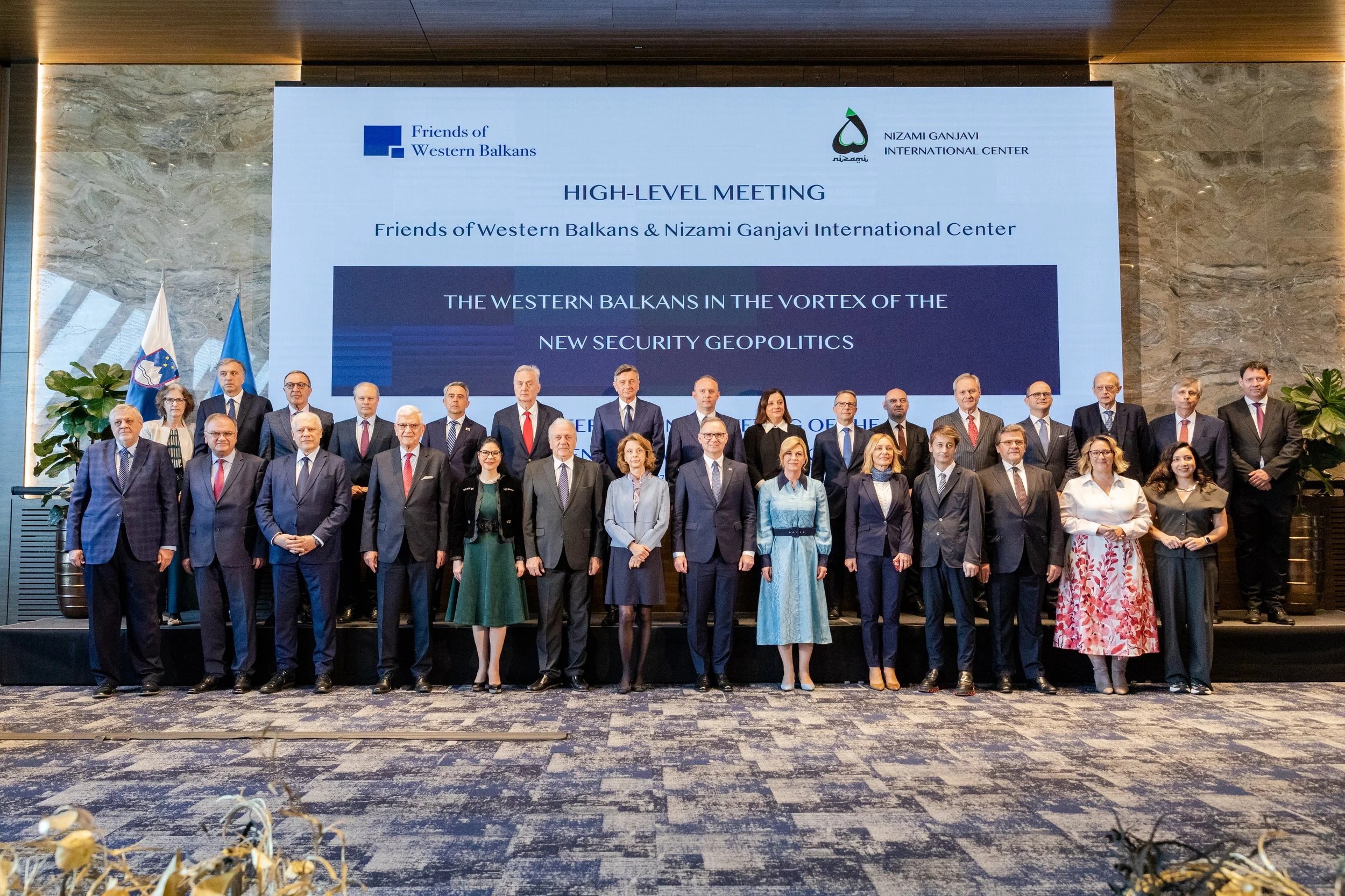
Ljubljana, Slovenia - III. International Conference of Friends of Western Balkans Institute, organised in cooperation with the Nizami Ganjavi International Center, is taking place today and tomorrow in Ljubljana under the title "The Western Balkans in the Vortex of New Security Geopolitics".
The conference brings together 35 distinguished speakers from 24 countries, further consolidating its position as a well-established and increasingly influential forum in the region and beyond.
This year’s event once again convenes high-level participants, including former and current heads of state and government, special envoys for the Western Balkans, senior foreign policy decision-makers, and leading experts in geopolitics, as well as European and Western Balkan affairs. Discussions focus on the implications of shifting security dynamics in Europe and globally, and their impact on the future of the European Union and its enlargement process.
The conference was formally opened by Borut Pahor, former President of the Republic of Slovenia and Founder and Director of Friends of Western Balkans Institute. He was followed by addresses from former Croatian President Kolinda Grabar-Kitarović and former Serbian President Boris Tadić.
In their opening remarks, speakers underscored the importance of political stability, security, and a credible European perspective for the Western Balkans amid increasingly complex global circumstances.
In his keynote address, Mr Pahor stressed: “The time has come to recognise that revising the enlargement strategy for the Western Balkans is a geopolitical necessity - one that cannot be achieved without reforming the European Union itself. This requires strong and unequivocal political will to transform the EU into a stronger union both internally and externally - moving towards a United States of Europe. With an ambitious enlargement policy, the EU must secure a space that rightfully belongs to it, or risk losing it. It is encouraging that accession negotiations with Montenegro are progressing; however, the Western Balkans will neither achieve lasting peace nor sustainable development until it is fully integrated under the European flag.”
He concluded with a forward-looking proposal: “I therefore propose a bold - but not reckless - strategy: that referendums on EU membership be held in all candidate countries in the region by 2030, and that the European Union itself prepares for this step within the same timeframe.”
The first panel addressed the evolving landscape of security geopolitics and its implications for the European Union and future enlargement. Opening contributions were delivered by former Presidents Andrzej Duda (Poland) and Rosen Plevneliev (Bulgaria), alongside senior representatives of the Council of Europe and the European Commission, as well as special envoys from France, Italy, and Slovenia for the Western Balkans. The discussion also featured leading experts in foreign policy, security, and defence.
Moderated by Volkan Bozkır, former President of the United Nations General Assembly and former Chief Negotiator for Turkey’s EU accession, the session developed into an open and interactive exchange among all participants.
A defining feature of this year’s conference is its structured, country-by-country focus on the political and security environment, as well as reform progress towards EU membership, across all six Western Balkan countries. This approach enables a more nuanced understanding of the distinct challenges and dynamics within the region.
The conference aims to foster open, substantive, and inclusive dialogue on the future of the Western Balkans at a time of profound geopolitical transformation. Proceedings began yesterday with a reception attended by the President of the Republic of Slovenia, Nataša Pirc Musar, who addressed developments in the Western Balkans and the broader international context.